
How to Check Criminal History in Marion County
Begin with a full name, exact spelling, an approximate date, and the kind of record sought. A case number is the best court key. An exact date of birth is required for an Iowa Division of Criminal Investigation check, but it is not a verified field on the free court form. A recent jail entry may answer a custody question yet say nothing about the later charge. Keep each result tied to its source and date.
The official Iowa Courts Online entry shows the frame-based search used for Marion County cases.
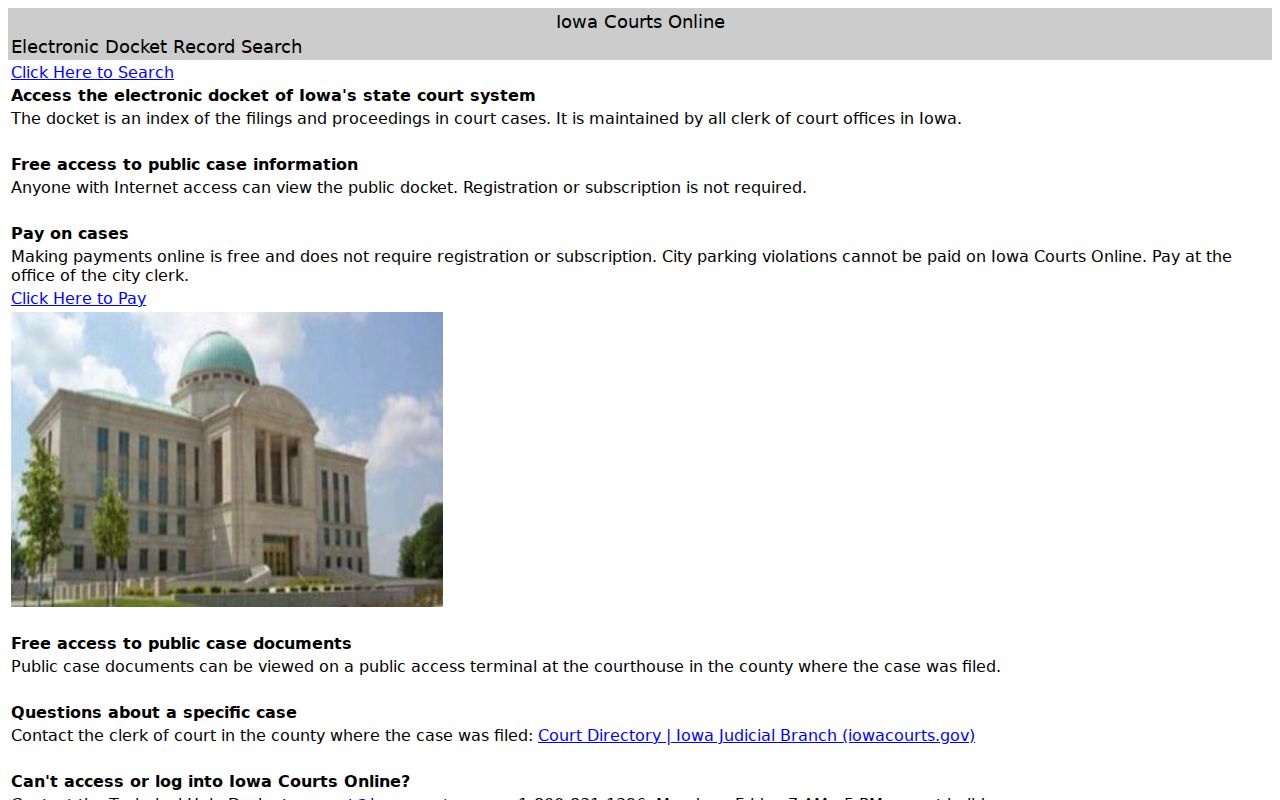
The state interface is the first online stop for a filed case, while the clerk supplies older files, public documents, and certified copies that the portal does not show.
- Search Iowa Courts Online by case number or party name and narrow the result to Marion County.
- Read the case status and docket in date order. Match details carefully before drawing a conclusion.
- Check the sheriff's Recent Arrests route when the question concerns current or recent county custody.
- Ask the arresting agency for its incident or arrest report. The jail does not hold every police narrative.
- Order the $15 DCI check when an Iowa repository response is the needed product.
The free court interface exposes only a small verified set of controls. Do not assume it accepts a birth date, offense, or date range.
| Court search field | Type | Use |
|---|---|---|
| Case ID or case number | Text | Best exact-key route when known |
| Name | Text | Search party names and check spelling variants |
| County | Dropdown | Select Marion to narrow a statewide result |
| Search | Button | Runs the public query |
Marion County's Two Record Counters
Two Knoxville buildings divide the main Marion County record work. The Clerk of District Court is on the third floor of the Marion County Courthouse, 214 East Main Street. Its phone is 641-828-2207, and public hours are 8:00 a.m. to 4:30 p.m. on weekdays. That counter handles filed criminal cases, docket documents, judgments, sentences, certified court copies, and questions about restricted court access.
The Law Enforcement Center at 211 North Godfrey Lane holds the sheriff and jail functions. Dispatch and the records-custodian route use 641-828-2220; the jail line is 641-828-2245. Administrative hours are 8:00 a.m. to 4:30 p.m. on weekdays. Use that office for sheriff reports, booking questions, recent custody, and local warrant guidance. The county court page shows the courthouse access details.
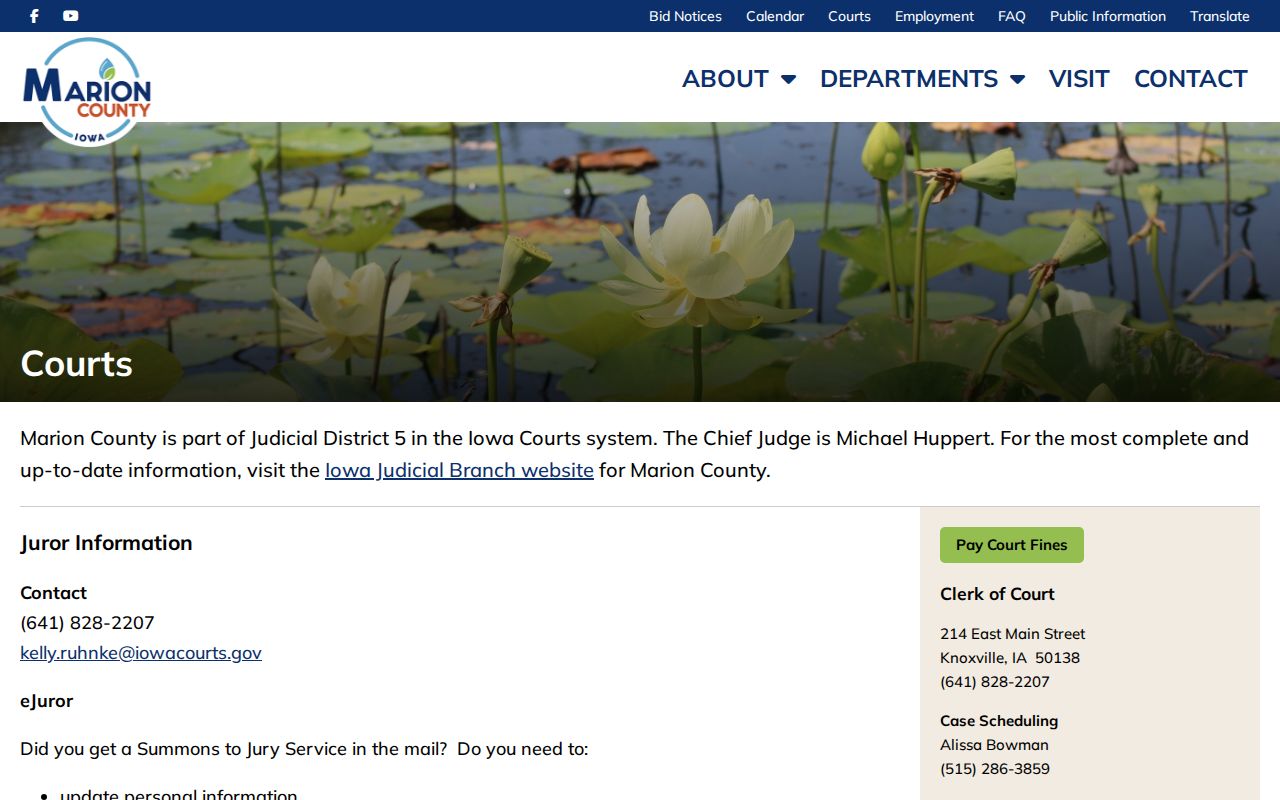
The separate counters explain why a court file and a police report can describe the same event but contain different facts.
Clerk of District Court
214 E. Main St., Knoxville, IA 50138
641-828-2207
Weekdays, 8:00 a.m.–4:30 p.m.
Sheriff Records Custodian
211 N. Godfrey Lane, Knoxville, IA 50138
641-828-2220
Weekdays, 8:00 a.m.–4:30 p.m.
Official Iowa Background Checks
The Iowa Department of Public Safety, Division of Criminal Investigation, Records and Identification Unit maintains the state repository. Iowa Record Check Online and the DCI request forms accept a first name, last name, and exact date of birth. A middle name, gender, or Social Security number can help distinguish people with common names. DCI charges $15 for each last name, so aliases or prior names need separate requests and payments.
Online, mail, fax, email, and in-person channels are available. Phone requests are not. The official channel generally reports processing of one to three days for submitted forms, while its broader FAQ gives an ordinary two-to-five-business-day range. Immediate counter results are limited to a subject checking their own record with government photo identification. A standard name check is Iowa-only, not a national FBI search.
The DCI criminal history page sets out those request channels and limits.
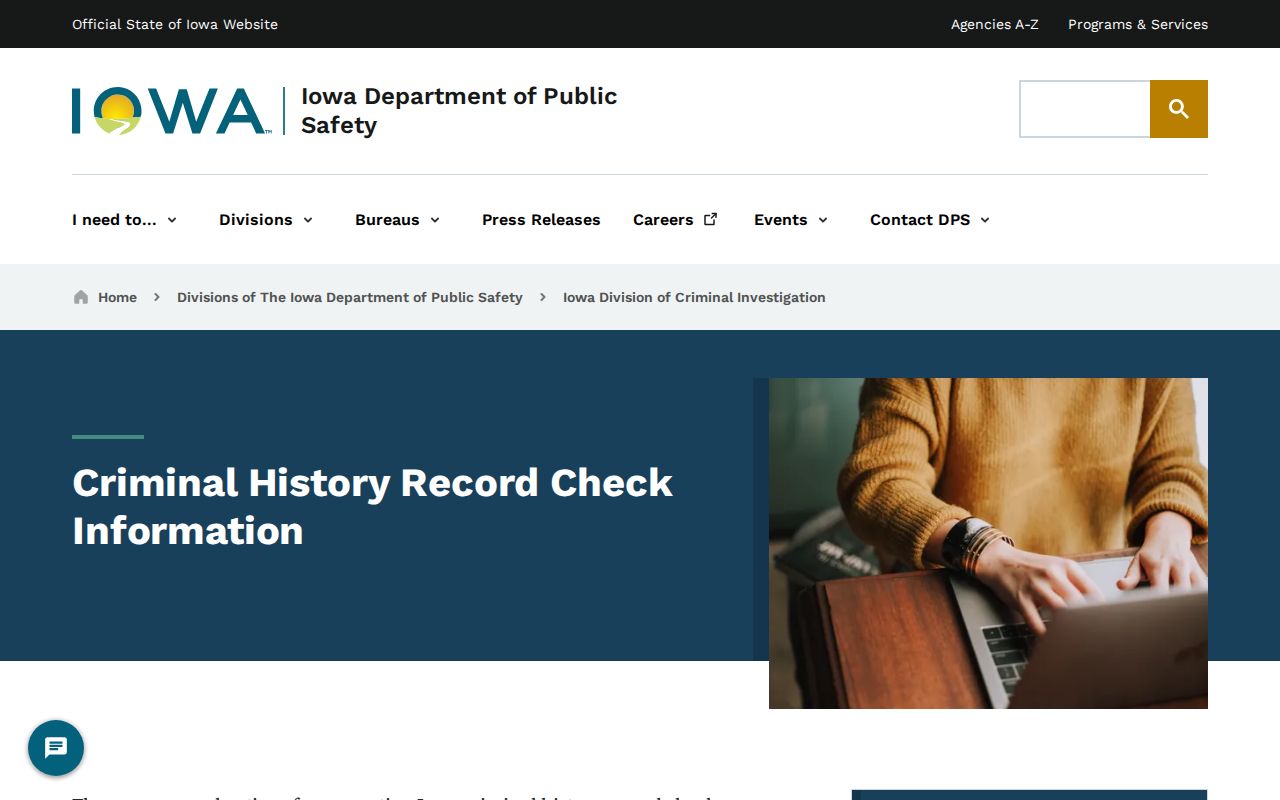
Use the DCI result as a repository response, then consult the court file when a charge, disposition, or sentence needs document-level confirmation.
| Official product | Scope | Fee |
|---|---|---|
| Iowa DCI record check | Releasable Iowa repository history | $15 per last name |
| FBI Identity History Summary | The subject's fingerprint-supported national summary | $18 direct FBI fee |
| Iowa Courts Online | Basic public Iowa case data | Free basic access |
Marion County DCI Record Limits
A DCI message stating “No Iowa Criminal History Found” has more than one meaning. It may mean no record exists. It may also mean available information is not releasable without the subject's authorization, or that the only information is confidential juvenile material. A discharged deferred judgment appears in the public response only when the subject signed the release. The result does not cover other states, every court case, or an FBI file.
Name and birth-date matching is not positive fingerprint identification. A person reviewing their own Marion County criminal record may challenge an error under Iowa Code section 692.5. DCI can ask for fingerprints and court proof to resolve the identity or disposition. Check the filed court record first, gather the judgment or expungement order, and then send the agency the documents it requests. This is especially useful when an old charge lacks its final court result.
Types of Criminal Records in Marion County
Marion County criminal records are created at different steps. A police incident report describes a call and the agency response. An arrest report states the asserted basis for custody. Jail staff create a booking record. Prosecutors and the clerk create the filed court case. DCI assembles reportable Iowa arrest and disposition information around identity data. The Iowa Department of Corrections later holds prison or community-supervision status.
- Police reports remain with the sheriff, Pella, Knoxville, Pleasantville, Melcher-Dallas, or the state agency that wrote them.
- Bookings are county jail intake records and are not findings of guilt.
- Court cases contain filed charges, events, pleas, orders, outcomes, and sentences.
- Warrants arise from a court or judicial officer and may have limited public visibility.
- Repository records compile releasable Iowa events but do not replace source files.
The source matters as much as the name. One event can produce several valid records with different dates, charges, and access limits.
Marion County Recent Arrest Records
The sheriff's official custody entry is labeled “Who's in Jail?” and routes readers to Recent Arrests. Its embedded vendor content may not load in a text-only or restricted browser. The public shell did not expose verified name, birth-date, or booking-number controls during research, so no unconfirmed search fields should be assumed. Call the jail at 641-828-2245 when current status is urgent or the embedded list fails.
The Marion County Recent Arrests page is the official web route for this limited custody view.
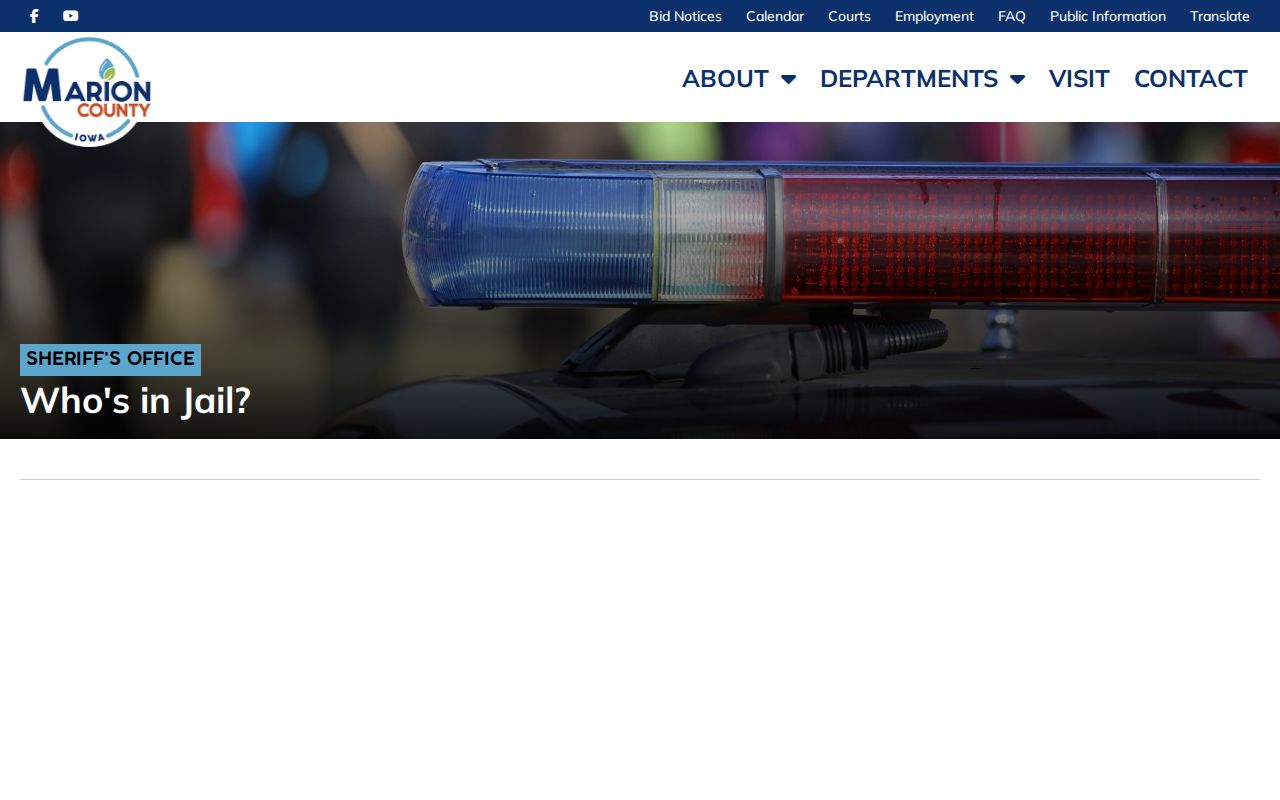
The listing does not replace the arresting agency's narrative, the clerk's filed case, or the later disposition. For the broader booking process and every documented lookup channel, use the Marion County arrest history resource.
What a Marion County Criminal Record Shows
Content depends on the custodian. A public court summary may identify the county, case number, filing date, status, parties, charge, statute, offense class, docket events, plea, result, sentence, and financial entries. A booking file focuses on intake time, agency, initial charge, bond, and custody. A DCI rap sheet arranges releasable Iowa arrest cycles and reported dispositions. Read the label on each field before comparing the records.
| Name and identifiers | Public display name and other lawful matching data; protected identifiers are withheld. |
|---|---|
| Arrest and booking | Date, arresting agency, intake charge, custody, and bond where released. |
| Charges and statutes | Alleged or filed offense, Iowa citation, count, and offense class. |
| Disposition | Conviction, dismissal, acquittal, deferred judgment, or another court result. |
| Sentence | Confinement, suspended term, probation, fines, costs, restitution, and conditions. |
| Custody or supervision | County jail status or a separate Iowa DOC prison, probation, or parole record. |
Public docket data generally covers trial cases after 1998. Older Marion County case records and public documents may require the clerk's counter or courthouse terminal.
Marion County Warrant Record Gaps
Marion County has no verified public name-search warrant portal. Iowa's Online Warrants and Articles system links criminal justice agencies, but it is not a public login. Public warrant checks therefore use a fallback chain: call sheriff dispatch at 641-828-2220, inspect Iowa Courts Online for a case event, and ask the Clerk of Court at 641-828-2207 about a known case. A focused Iowa Open Records Law request can seek releasable agency information.
Sealed, juvenile, and active investigative material may remain unavailable. A web docket can also lag after a warrant is recalled or served. Anyone addressing their own warrant should confirm the current status with the issuing court and law enforcement and obtain advice on appearance, bond, or recall. A phone call or search result does not clear the warrant.
Public Access Laws for Marion County Criminal Records
Iowa law provides access by record type rather than declaring every criminal history detail open. Chapter 22 governs agency inspection and copying, while chapter 692 controls the state repository. Court rules set public electronic access levels. Juvenile cases, expunged matters, victim and minor identifiers, intelligence data, medical information, and other protected material may be withheld or redacted.
Key Iowa authorities:
Iowa Code chapter 22 grants public inspection and copying rights while preserving statutory confidential records.
Iowa Code section 692.2 governs DCI dissemination and permits a reasonable record-check fee.
Iowa Code section 692.5 gives the subject a right to inspect and challenge Iowa criminal history data.
Iowa Code chapter 901C makes qualifying expunged case records confidential.
Ask for the narrow record needed, request an estimate before paid copying, and verify a denial or redaction against the cited law.
Marion County Sheriff's Record Requests
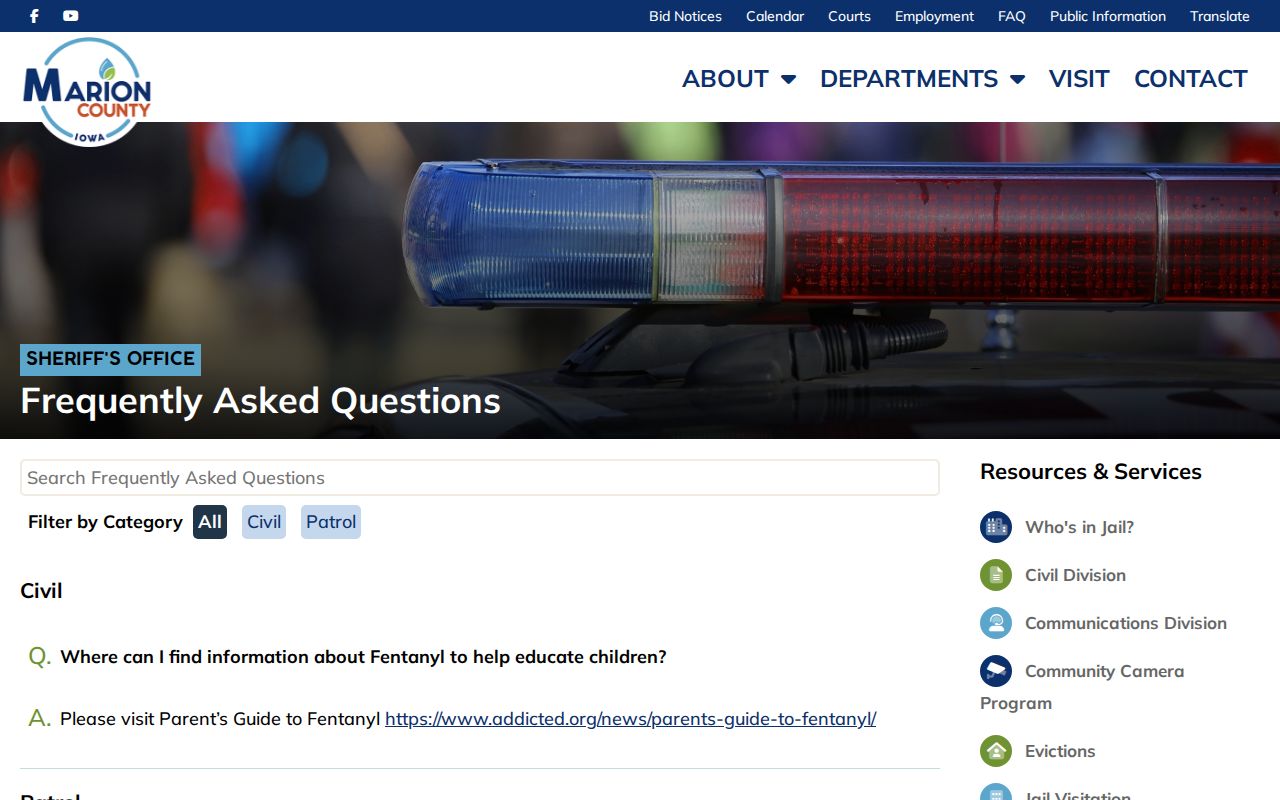
The sheriff does not publish a stand-alone Records Division portal or a downloadable report form. The official route is direct: call 641-828-2220 and ask for the records custodian. Some charges may apply, but the county does not publish one universal copy fee, certification fee, identification rule, or delivery deadline. Confirm those terms for the specific incident, accident, or arrest report before ordering.
The sheriff's records FAQ documents that phone route and sends complete criminal-history requests to DCI.
A useful request identifies the event date, location, responding agency, incident number if known, and the desired medium. For a formal county request that does not fit the routine counter route, the county Public Information Officer is Emily Feagins at 641-205-3721.
The official sheriff page also shows the local office and service contacts.
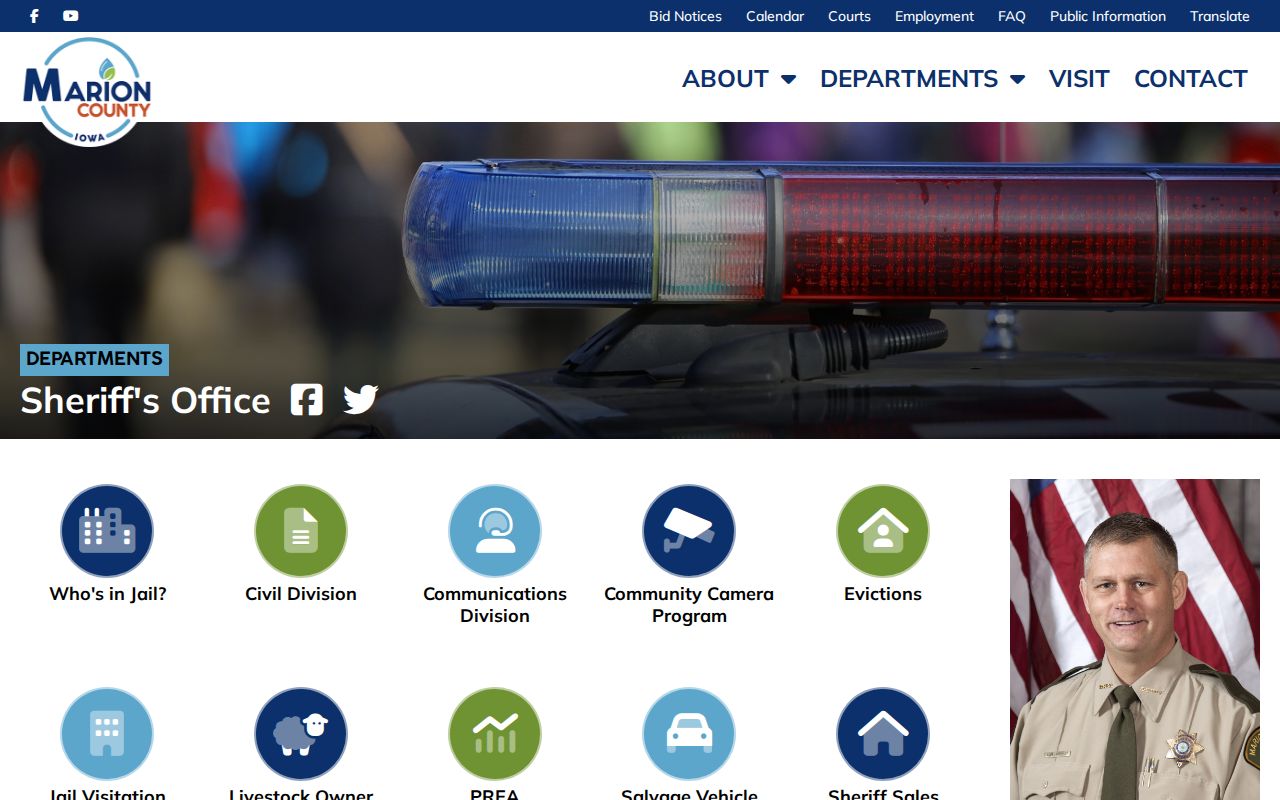
The sheriff covers unincorporated territory and several smaller communities, so that office may be the creating agency when no city police department handled the event.
Sealed, Expunged & Restricted Records
Iowa expungement makes a qualifying court record confidential and can direct removal of an entry from DCI files. It is not a broad promise that every copy disappears. Iowa Code section 901C.2 covers qualifying dismissed or not-guilty cases. Section 901C.3 creates a limited remedy for eligible misdemeanor convictions after more than eight years, subject to exclusions, payment of obligations, the absence of pending charges, and other statutory conditions. Section 907.9 addresses discharge from a deferred judgment.
File the current Judicial Branch application in the Iowa District Court for Marion County, where the case was heard. Use the case number and exact disposition, and select the form for the correct legal route. The research did not locate a current expungement-specific filing fee, so ask the clerk rather than assume a price. After an order is processed, check Iowa Courts Online and obtain a new DCI self-check. If the repository still shows the matter, send DCI the order through its correction process.
Marion County Supervision Records
Probation and parole are state-operated in Iowa. Marion County is served by the Fifth Judicial District community-based corrections structure, which handles probation, parole, pretrial services, residential placement, and related supervision. A court docket shows the sentence and later filed events. Iowa Offender Search may show a prison or supervision status. The Iowa Board of Parole makes parole release decisions, while Iowa DOC district staff supervise people after release.
The Iowa DOC inmate and family services page is the official entry to the offender-search channel.
The state locator is not the Marion County jail roster. Presentence reports, treatment records, risk material, and full supervision notes are not made public just because a basic status can be confirmed.
Criminal Records by City in Marion County
Pella, Knoxville, and Pleasantville are Marion County's three largest incorporated cities in the official 2024 estimates. Each police department keeps the reports it creates, while county jail bookings route to Godfrey Lane and filed state cases route to Iowa District Court. Iowa abolished municipal courts, so none of these cities has a separate municipal criminal court. City parking matters remain outside Iowa Courts Online.
Pella Criminal History
Population estimate 10,965 · Pella Police records, public portal, and weekly reports.
Knoxville Criminal History
Population estimate 7,440 · Police records counter, courthouse, and jail routes.
Pleasantville Criminal History
Population estimate 1,696 · City police record duties and City Hall request route.
Pella dispatches its own police service. Knoxville has three distinct record counters within the county seat. Pleasantville has no online blotter, but its city code requires a local arrest record. Those differences make the city-specific channel the right starting point for a police narrative.
Marion County Courthouse Record History
The present courthouse is the county's third. Marion County's first supervisors met in a cabin in 1845. A log courthouse followed and served as court, school, and place of worship. The next brick courthouse was damaged by an 1895 windstorm and condemned. Voters approved a replacement, and architect Mifflin E. Bell designed the Queen Anne and Romanesque building completed in 1896. Later residents chose modernization over replacement, adding features such as an elevator and remodeled courtrooms.
The official Marion County history presents the courthouse as both a landmark and an active public building.
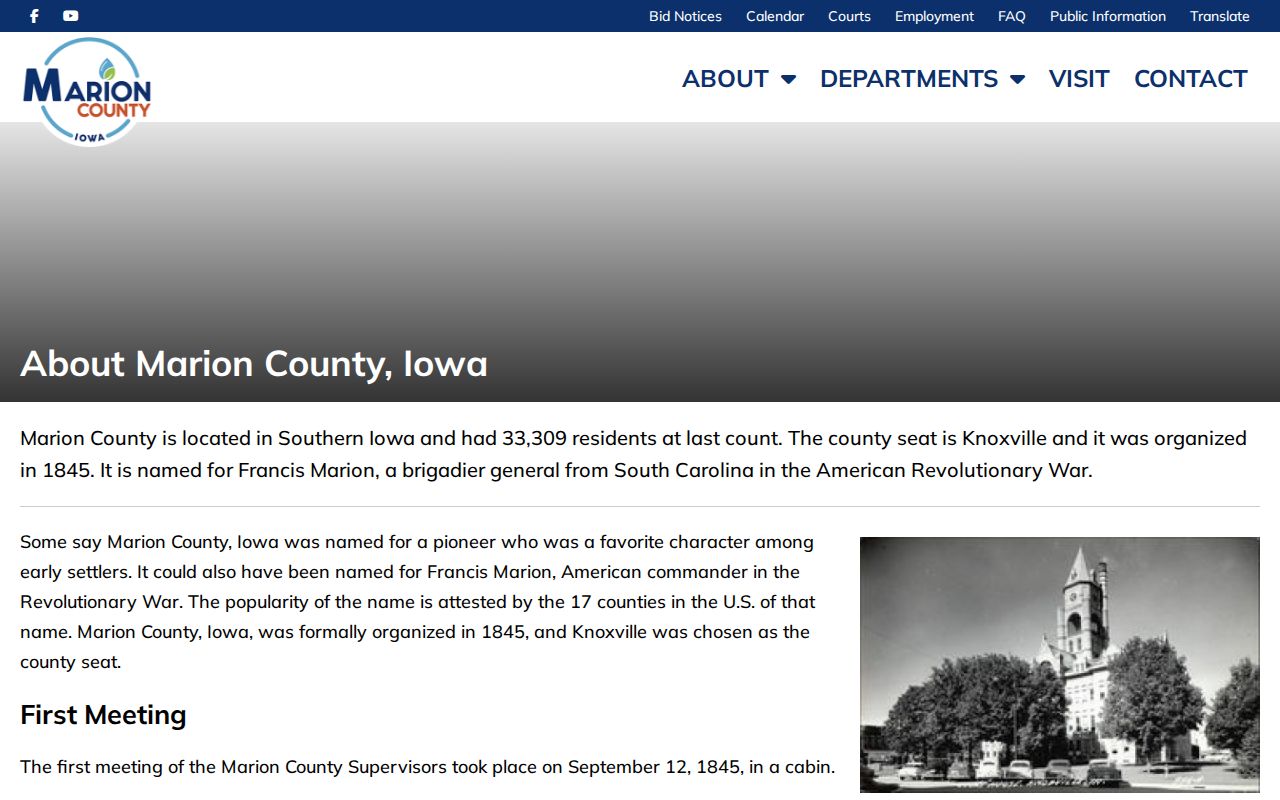
The third-floor clerk counter still joins that history to daily record access. Visitors are told to use public lots one block north of the square for longer stays. The first floor displays the original Iowa flag design, and courthouse grounds include the Dixie Cornell Gebhardt memorial and Red Rock Line marker.
The Iowa registry's advanced-search page illustrates another state record channel used in Marion County.
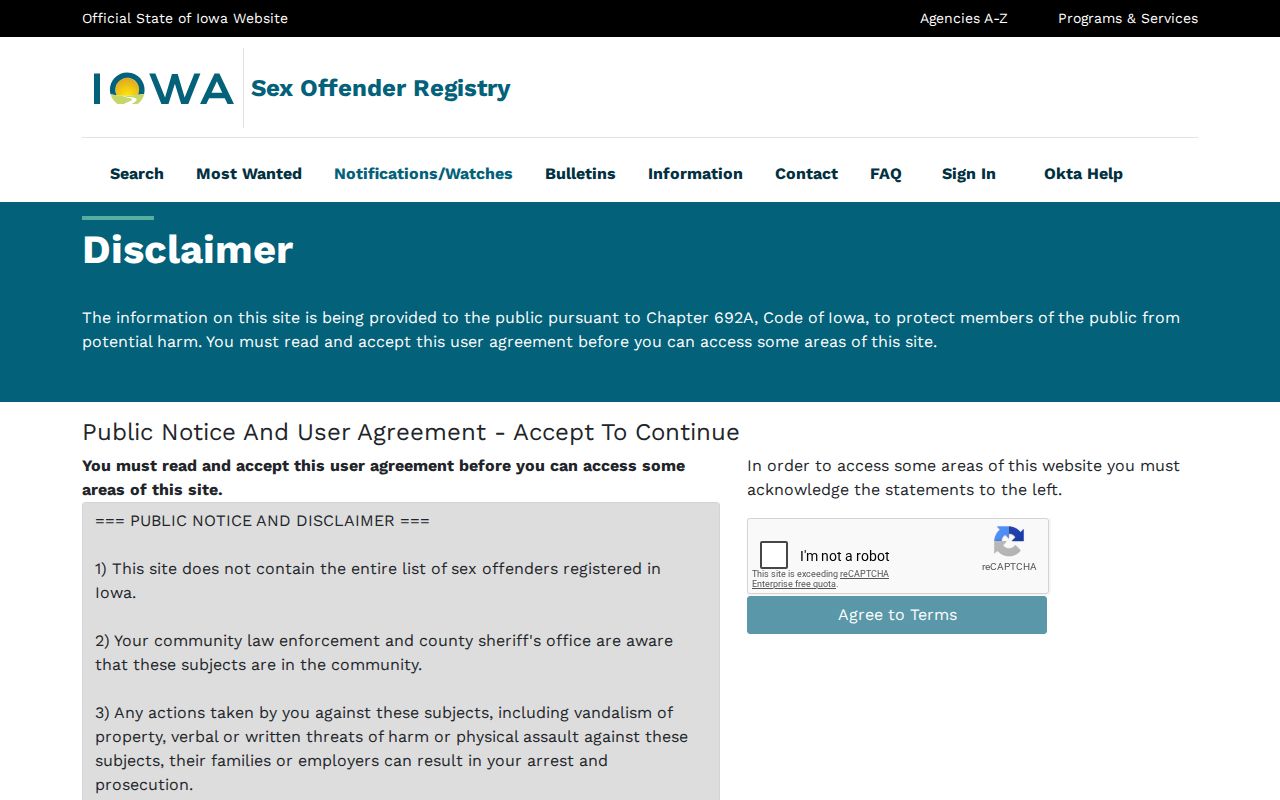
Registry profiles follow separate chapter 692A rules, require acceptance of the official notice, and should be verified with the sheriff when accuracy or current local status matters.