
How to Check Criminal History in Knoxville
Knoxville has no single public police blotter or city criminal-history database. Begin with the records desk when the goal is a city police report. Move to county custody records for a booking, the district court for a filed case, and DCI for an Iowa repository response. Each step answers a different question.
- Call the Knoxville Police records and business desk at 641-828-0541 or visit the counter with the clearest event, person, case, and date details available.
- Send a clear request by counter service, telephone, fax, or mail. Confirm the current fee, identification rule, redaction estimate, and delivery channel before ordering.
- Use Marion County's official Who's in Jail and Recent Arrests interface, or call the jail at 641-828-2245, when custody is the issue.
- Search Iowa Courts Online with Marion County selected. Use the Knoxville courthouse terminal or clerk when the free docket lacks a needed public document.
- Order a DCI Iowa Record Check when a statewide repository result is needed. The $15 name check uses first name, last name, and exact date of birth.
The Knoxville report may contain officer observations that never become a filed charge. The Knoxville court file may show an amended charge or disposition that the first police report cannot. The Marion County criminal history overview covers the county and state layers in more depth.
Three Knoxville Criminal Record Counters
Knoxville's justice geography is compact, yet the offices are distinct. Knoxville Police shares the municipal complex at 305 South Third Street. The Marion County Clerk of District Court works at the courthouse at 214 East Main Street. The Marion County Law Enforcement Center and Jail is at 211 North Godfrey Lane. A short distance does not merge their files.
| Knoxville counter | Core record | Best use |
|---|---|---|
| Police records desk | Incident, arrest, accident, citation, and local report | What Knoxville officers recorded |
| District Court clerk | Complaint, trial information, docket, order, disposition, sentence | What became a public court case |
| County jail | Booking and custody entry | Recent arrest or current custody status |
Ask the Knoxville office for the record it owns. Knoxville police staff cannot turn a report into a certified court disposition, and jail staff cannot supply the complete police narrative. Knoxville's three-counter setup makes that distinction visible.
The Knoxville Police Department
The Knoxville Police Department is at 305 South Third Street, Knoxville, Iowa 50138. Its records and business number is 641-828-0541. The 24-hour non-emergency number is 641-828-0554, and the fax is 641-828-0555. The department says most enforcement takes place within roughly five square miles and describes work with the Marion County Sheriff, Iowa State Patrol, and area agencies.
The official Knoxville Police page is the primary source for Knoxville department contacts and programs.
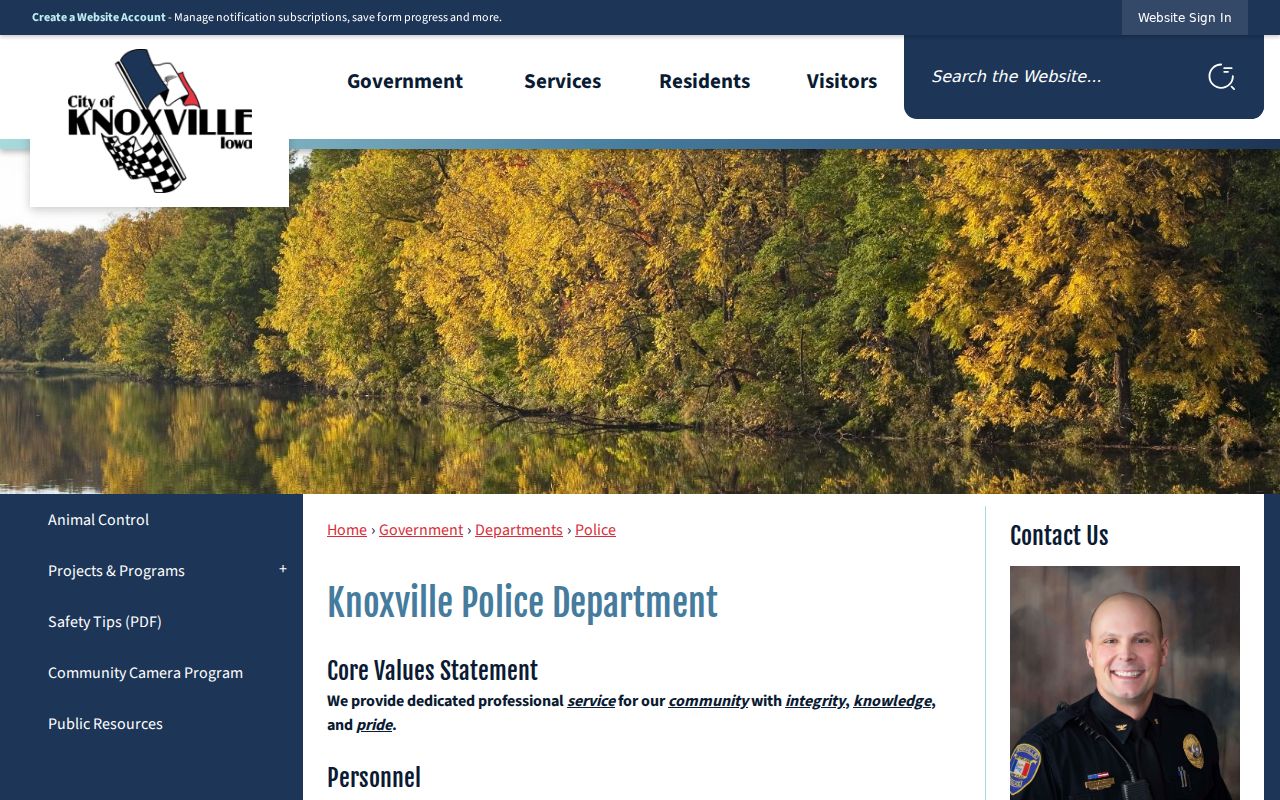
The Knoxville department page identifies the first custodian for Knoxville police records, while county and state offices hold the booking, court, and repository records that may follow.
Knoxville Police Records
305 S. Third Street
Knoxville, IA 50138
641-828-0541
Call to confirm records hours, fee, identification, and turnaround.
Knoxville Police Record Clerk
A 2026 Knoxville Record Clerk position description confirms the work behind the Knoxville counter. Knoxville staff process arrests and traffic citations, enter data in police and state electronic systems, assist with record requests, prepare report copies and local background checks, answer counter questions, and receipt payments. This Knoxville source supports the counter's role without implying that each product is a statewide history.
Knoxville has not posted a dedicated public police-record form or online arrest blotter in the official navigation reviewed for the research. The practical route is therefore direct: describe the incident, arrest, accident, citation, person, or date as clearly as possible, then use the counter, phone, fax, or mail. Ask whether another submission method is accepted before sending sensitive identifying details.
- Locating details
- Give the incident, case, person, date, and report type known to the requester.
- Request channels
- Use the counter, phone, mail, or fax; confirm any electronic option with staff.
- Products confirmed
- Report copies and local background checks are named in the official job description.
- Fee and identification
- No current official schedule was located, so ask the records desk before ordering.
- Parking appeal
- This is a separate city form, not a criminal case or criminal-history search.
Arrests and Bookings in Knoxville
Knoxville Police generally routes a person entering county custody to the Marion County Law Enforcement Center and Jail on North Godfrey Lane. The police report stays with Knoxville. The booking entry belongs to the Sheriff's jail system. If a prosecutor files a charge, the court file begins at the clerk. That split matters most in the first days after an arrest.
Check the official Marion County Who's in Jail and Recent Arrests interface for Knoxville custody. Call the jail at 641-828-2245 when the interface does not answer the Knoxville question. Then check Iowa Courts Online for a filed case. A missing Knoxville docket can mean no charge was filed, data has not appeared yet, or a search identifier differs. It does not erase the possibility of an earlier Knoxville police contact.
Note: A Knoxville booking documents custody at intake and is not proof that the person was convicted of the listed charge.
Knoxville Records Without a Blotter
The lack of an official online Knoxville arrest blotter changes the order of Knoxville work. Call the Knoxville police records desk first for a report created by Knoxville officers. Use the county jail interface second for a Knoxville booking. Search the district court third for a filed charge and later disposition. This Knoxville fallback chain is more reliable than treating one empty search screen as a final answer.
After hours, the Knoxville police lobby has an intercom to a dispatcher, according to the department's Knoxville Nationals FAQ. That Knoxville intercom supports access to dispatch. It does not promise a 24-hour Knoxville records counter, copy service, or immediate local history response. Non-urgent Knoxville records work should go through the business number, with staff availability confirmed.
For council-level context, official Knoxville agenda packets include monthly police reports. The research located a June 2025 report accepted in a July council packet. Such attachments may document agency activity, but a council report is not a court disposition and should not be used to infer a city crime rate without a clean, defined data series.
Knoxville Municipal Court Records
Knoxville does not have a municipal court. Iowa's Unified Trial Court Act of 1973 abolished municipal, mayor's, police, and justice-of-the-peace courts. Criminal cases, scheduled violations, and prosecuted Knoxville ordinance matters use the unified Iowa District Court. Because Knoxville is the county seat, the Marion County courthouse and its public document terminal are in the same city.
| Court Name | Iowa District Court for Marion County; no Knoxville municipal court exists. |
|---|---|
| Case Types Heard | Criminal cases, scheduled violations, and prosecuted ordinance matters within District Court jurisdiction. |
| Case Lookup Channel | Free Iowa Courts Online, the courthouse public terminal, and the Clerk of District Court. |
| What the Docket Shows | Public parties, charges, filings, events, disposition, and available financial data. |
| Copies & Fees | Ask the Marion County clerk for the current plain or certified copy fee. |
Knoxville parking matters are the exception. City parking violations do not appear or accept payment in Iowa Courts Online. A parking appeal follows the city police form and administrative route, not the District Court criminal docket.
Knoxville Court Search Limits
Free Iowa Courts Online supplies basic public docket access without registration. Select Marion County to narrow a Knoxville case search. Search a Knoxville case by a known case ID when possible, or use the available name and citation routes. Some Knoxville citations may take 14 to 21 days to appear. If a Knoxville citation still cannot be found, call the clerk rather than guessing about its status.
| Portal control | Access | Knoxville use |
|---|---|---|
| Click Here to Search | Free public docket | Start a basic Marion County case search. |
| County | Public filter | Select Marion for local court matters. |
| First and Last Name | Name route | Enter at least two characters of each where the payment search requires them. |
| Case or Citation Number | Identifier route | Use the full case ID or citation number when known. |
| Advanced Case Search | $25 monthly subscription | Adds search detail but does not unlock public document images. |
Public Knoxville court documents are viewed through a courthouse terminal. An Advanced Case Search subscription adds fields such as scheduling, traffic, judgment, lien, exhibit, service-return, and financial search data, but it still does not provide Knoxville court document access. Technical help is available at 1-800-831-1396 on weekdays from 7 a.m. to 5 p.m.
Where Knoxville Records End Up
Knoxville Police makes the city incident or arrest report. The Marion County jail makes the custody entry. The district court clerk opens a case only when a complaint or trial information is filed. Courts and agencies then report qualifying arrest and disposition data to the Iowa Department of Public Safety's Division of Criminal Investigation.
Record flow: Knoxville Police Department › Marion County Courts › Iowa DPS Division of Criminal Investigation.
Each Knoxville record can change at a different time. The Knoxville police report may be ready only after review and redaction. A Knoxville jail record can appear at intake. Court data generally appears about one business day after entry, while a clerk document may take several days. DCI's repository response is an Iowa history released under chapter 692, not a copy of the full Knoxville police file.
Knoxville Camera Registry Records
Knoxville's Community Camera Program is a voluntary registry. Participants tell police where a camera is located. Registration gives police no remote access and does not require anyone to share footage. Officers may contact a participant when nearby video could aid an investigation.
The official Knoxville Community Camera Program is best read as a Knoxville investigative aid, not a criminal-history portal. A Knoxville registry entry does not show that a crime occurred at the address or that the registrant is tied to a case. If footage is voluntarily provided, it may enter a Knoxville police file and become subject to Iowa access, confidentiality, and active-investigation rules.
Knoxville also describes community policing, reserve officers, a school officer assignment dating to July 2013, a drug-task-force partnership, traffic-safety work, and ride-alongs. These programs can create reports, citations, or other agency records. They do not turn each contact into an arrest or court case.
Knoxville Police Activity Reports
Knoxville council packets can contain monthly Knoxville police reports. These attachments are useful Knoxville primary records for a defined month when the packet clearly labels the period and measure. They should not be stretched into an annual Knoxville trend or compared to Pella figures without matching definitions.
No clean current annual Knoxville offense table was found in official city navigation during the research pass. That gap matters. Calls for service, arrests, citations, reported offenses, and convictions are different measures. A Knoxville council packet may describe department work, while Iowa Courts Online shows judicial cases and the FBI or Iowa UCR program uses its own reporting framework. Keep the source, agency, period, and metric attached to any number.
This caution is especially useful during the Knoxville Nationals, when the city's official FAQ addresses police access and after-hours contact. Event traffic can affect service activity, but the reviewed source does not support a claim about criminal-history trends.
Missing Knoxville Criminal Records
When a Knoxville record is absent, test the Knoxville handoff points. First confirm the spelling, event date, and report type with the Knoxville police records desk. Next check whether the person entered the county jail after a Knoxville arrest. Then search Marion County court records by case ID or name. A Knoxville citation may need 14 to 21 days, and a court document may lag behind the docket entry.
If a free docket shows the case but not the document, use the Knoxville courthouse terminal or ask the clerk about a public copy. Advanced Search is not a document-image service. If the dispute concerns a DCI response, Iowa Code section 692.5 lets the subject inspect and challenge their own state criminal-history data. DCI may ask for court proof or fingerprints to resolve identity or disposition questions.
A separate city parking appeal should stay with Knoxville. It will not appear simply because the same name or citation details were entered in the state court portal.
Public Access Rules for Knoxville Records
Iowa's public-record framework covers Knoxville agency records, but access is not absolute. The city may redact or withhold material protected by law, including confidential personal data, victim or minor details, intelligence information, and records whose release is restricted by a specific statute. Court rules separately control electronic court access, and chapter 692 controls DCI dissemination.
Key Statutes:
Iowa Open Records Law, chapter 22 grants inspection and copy rights while section 22.7 identifies confidential records.
Iowa Code § 692.2 controls DCI release of criminal-history data and allows a reasonable fee.
Iowa Court Rules 16.601 through 16.605 set access levels for electronic court records.
Ask Knoxville Police for the city report, the clerk for the public court file, and DCI for the Iowa repository response. A redaction in one record does not authorize release through another office. Juvenile, expunged, sealed, and other confidential records remain outside ordinary public access.